

WHY TAKE THE
CRASH
COURSE?

Universal stories
You will find out how the words coming from your partner's mouth are not original nor come from unique circumstances, but rather from a very commoun outcome of the conditions you live under.

Learn to read values
How often do you hear the phrase: "know your worth"? It's a well meaning piece of good advice, but how?
You will be guided through an actual math of values both personal and social and how to know not only your "innate worth" but also your "perceived" one.

Negociations and exit
Whether you want out or you wish for a mere breather, you will know that there are so many ways to do so on a scale of assertive to malicious.

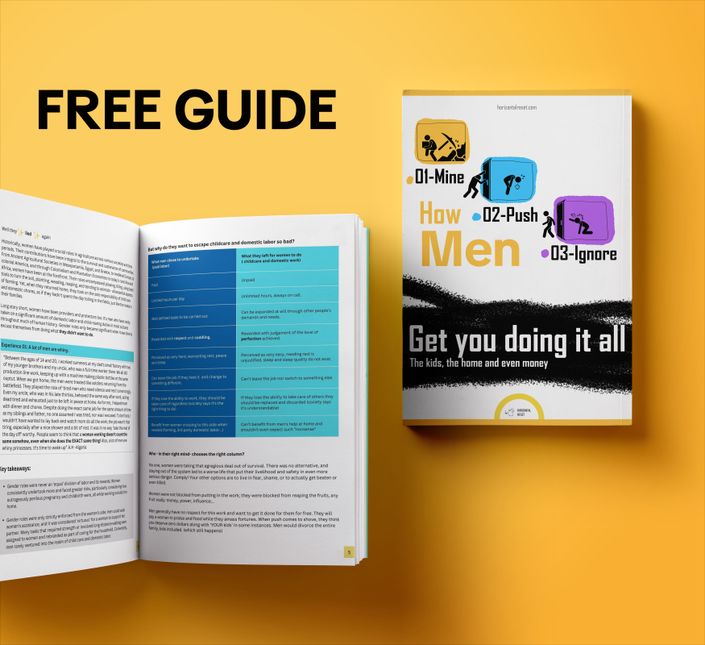
Download the free guide
Learn how women end up with men who put them in unvoluntary servitude with no hope of being heard or seeing change.

Course Curriculum
- CHECKPOINT: some partners need a sit down, others need to be let go.
- 1- The fairness scale: from the brute to the reciprocal
- 2- The automatics scale: from the royal to the self-sufficient
- 3- The knowledge scale: from the switcher to the leader
- 4- The belief scale: From the ideology of worth to the individual theory
- 5- The learning scale: From the ego weaver to the mindful learner
- QUESTION TIME: Was there a special circumstance, a new birth or health issues ?
- CHECKPOINT: You have to know this about yourself before any demands or changes
- 1- Your time: you can refuse to sell all of it. In fact, it's exactly what you should do
- 2- Your health: The second co-determiner of your quality of life
- 3- Your energy: physical, emotional and mental energizers / drainers.
- 4- Your vision / direction: Attention, Focus, analytical and critical skills + Imagination
- 5- Your knowledge: Your only bet to make a vision into reality
- 6- Associations: People you trade time, money, energy and thoughts with are important
- 7- Your personal brand: physical appreance, reputation, likeablity and charisma.
- 8- Your money: monetary assets under your control / name.
- 9-Your enlightenment: Contentment, peace and happiness
- QUESTION TIME: Why did you sell your Toyota Corolla for 5 dollars to THEM?
- CHECKPOINT: this is not the life you want, what is?
- The dangers of communicating unspecified needs.
- STEP 1: Life chart - an audit
- STEP 2: Set your priorities, direction and vision
- STEP 3: Creating the first buffer - your first excercise in creating space
- STEP 4: What does balance look like to you as an individual?
- STEP 5: How much space needs to be created for this to be possible?
- STEP 6: Is that extra space possible with the configuration of people / assets you have now?
- QUESTION TIME: are you afraid of conflict?
- CHECKPOINT: The partner shall know exactly what's up and so will you.
- You know mansplaining, do you know manslating?
- Communicate the need and a unilateral design
- Offer to work on a mutual design
- The cake seller: Takebacks are hard
- Prepare to be made to feel worthless and/or asking for the impossible
- Prepare also to be heard and given INITIAL validation
- QUESTION TIME: what communication styles can be used with your partner?
- Ask them to do their time use table, help them do that
- Hand them your time use table, go through it, explain it.
- Halt all values they benefit from which you don't: gym time, leisure, travel...
- week 1: a week of your complete absence
- week 2: a week of following your time use table
- Discuss the tools and the plan ahead
- QUESTION TIME: how much did they cooperate with the preparation phase?
- New currency: Valcoin
- Two self charts
- A joint life chart: House, child, car...
- Rules of the joint life chart
- Trap 1 : drip vs stash
- Trap 2 : time and space constraints. some tasks make you be somewhere at some specific time
- Trap 3 : free vs paid
- Trap 4: handling their coins before your wads
- The other 10 traps
- Temporary special circumstances: plan for the normal
- QUESTION TIME: how much of an "alien" did they prentend to be?
- CHECKPOINT: some ways are petty, some are toxic and some are assertive.
- Principle 1: no harm, no abuse, no gaslighting
- Principle 2: each approach has consequences on your mental and emotional self
- Principle 3: each approach has consequences on the bond you share
- Principle 4: don't offer benefits you are not afforded
- Choose your player: Are you petty or are you scheming?
- Engineering blocks / impasses
- Initiating multiple propagations into the value chain
- Fragmentation of the joint life
- A last resort: withdrawal - be willing to buy yourself.
- QUESTION TIME: Are they already checked out? and to what extent ?
- CHECKPOINT: Track progress outside of the excuses and the temporary gestures
- Do NOT play coach or supervisor
- Signs of gaming the agreement: prentending, decrescendo, theatrics, anger ...
- Signs of compliance: results, absence of emotional negativity surrounding the new normal.
- Repeated failure despite honest effort. Back to the Valcoin bank.
- Stealth exit or Covert exit: When the partner decides they want to go back to doing nothing
- Re-classify your post agreement partner
- QUESTION TIME: How much time is enough time to see change?

Hi, I am Sam
I am a general practitioner (MD) and an educator.
In recent years I have witnessed that the women around me (mostly married) have all been complaining about pretty much the same patterns, the same issues, the same everyday headache, and wondering how to work "around" their issues being the mom, the dad, the provider and the maid for almost absent partners.
I have been studying the psychological and social structures, trying to understand why would people give up some of their "fair share of the pie" to accommodate people who not "need" but want/demand more than they deserve? Is it kindness? Is it compromise? The thing was that it was almost always the same individual getting the short end of the stick EVERY TIME.
This led me to recognize the critical importance of addressing the issue of unpaid domestic labor. It's not only pervasive and heart-wrenching, but it's also a personal struggle I endured in a country ranked among the top 10 for domestic labor inequality worldwide.
